Showing posts with label Cycling Safety. Show all posts

Thursday, April 24, 2014

Well, Actually. Yes...

Bike Lanes Everywhere


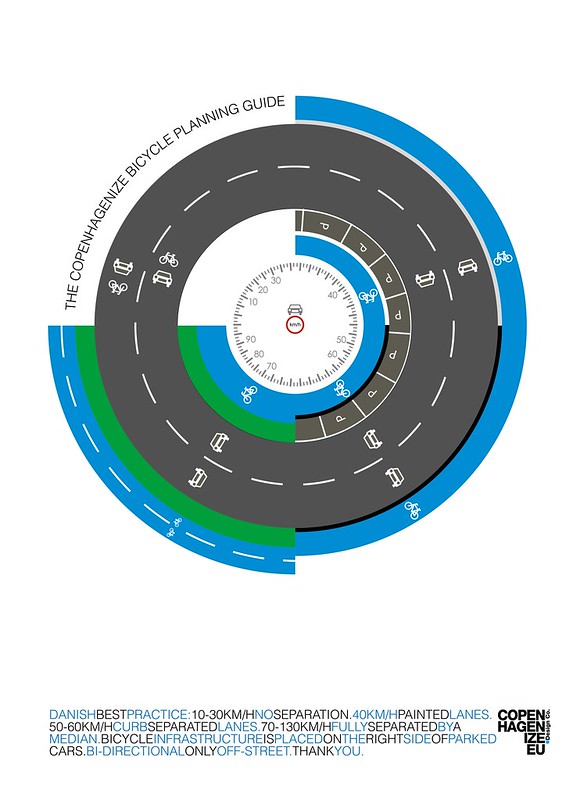
I really admire Copenhagenize.com and what ever you think about Cycle Chic or Mikael Colville-Andersen himself. You've got to admit, "The Copenhagenize Guide to Liveable Cities", has some great graphics. The two below are my favourites. The simplicity and clarity of these graphics is really apealing, at least to me. More importantly the message is clear and unambiguous.  


I used the circular "The Copenhagenize Bicycle Planning Guide", in a recent post "Bike Lanes Everywhere!" Where traffic volumes and effective speeds are low, the need for infrastructure is likewise low. As volume or speed increase the need for infrastructure also increases. I framed this as protection from the "confined to" fear of some cyclists.
But, that isn't the whole story. It is also an inoculation against terrible, inadequate and unnecessary infrastructure. There are many examples of this along Ottawas East West Bikeway:
for example Wilbrod St.

View Larger Map

Wilbrod is a quiet One Way Street with negligible traffic volumes. In fact the school pictured above blocks the road twice a day to load/unload its school buses. A counter-flow lane like Cameron St. in Old Ottawa South would be nice:
 
View Larger Map
As it stands, Wilbroad's east bound cycling lane is frankly unnecessary.
Another example of an unneeded cycle lane would be Monk St. in the Glebe:

View Larger Map
Monk St. is on my regular commuting route. Especially with the construction in-front of Lansdown Park but the bike lane is superfluous, and once Bank St. returns to normal and the construction trucks are not there I will once again continue north to Fifth St. rather then make the awkward left off busy Bank St. onto Wilton Cr. Heading south I never take Monk St. Wilton is actually quite busy, with cars accessing or exiting Queen Elizabeth Drive. What cyclist wants to come to a full stop before a difficult right and a steep hill over one of the most complained about bridges, in Ottawa. Monk St. is not a south bound route.
There are many other examples: Sherwood Drive is trying traffic calming by bike. Sharrows and single file signs to slow cars down. really adds nothing for cyclists. St. Patrick really a continuation of highway 50 and the Vanier Expressway is slatted to get sharrows, this is insultingly inadequate.
I strongly believe that all of these complaints could be averted with the adoption of the two posters at the start of the post.
I love my bike, cycling makes me happy. I am motivated to choose cycling over driving but I don't always. Driving is a convenience, it is easy. I can guilelessly listen to the radio there is heat/air conditioning... Privileging walking/cycling over private autos is merely levelling the playing field. That is the first poster. Car journeys don't need to be direct or easy, in fact they should be difficult and convoluted. Otherwise, transit, walking or cycling will not appeal to any but  a tiny minority.
Adhering to the principles in the second poster is vitally important as well. Objective and subjective safety cannot be achieved without appropriate, consistent infrastructure where required and recognition of where it is not. A dense, comprehensive and complete cycling network is key to getting people to chose to cycle. Knowing where to concentrate efforts is how we get from here, to there.

Saturday, April 19, 2014

The Value of Sharrows...

Sharrows (pictured below) are newish road markings. A bicycle stencil beneath double chevrons. They are meant to convey several messages to all road users. These messages can be broadly grouped under: "Bikes Belong"

Sharrow on Bank St. bridge over the Rideau
To the motorist the messages are: "Bikes Belong" here, in the lane. Slow down, be patient...

To the cyclists the similar messages: "Bikes Belong" here. "Take the Lane" or at least move away from the curb...

Ottawa has gone sharrow mad painting them on all sorts or roads. The one pictured left was painted on the Bank St. bridge over Rideau River. I wrote about this bridge before, "Solution for scary bridges". That was almost two years ago, the no passing cyclists in the lane was abandoned in favour of sharrow lane markings.  You can even see them in the satellite view on Google maps, pictured below.


View Larger Map
So the million dollar question: do they work?
Do they influence the behaviour of motorists or cyclists?
Are cyclists comforted, emboldened, welcomed to the street?
Last time I wrote about this bridge I caught a couple crossing on the sidewalk.
Crossing Bank St. Bridge over Rideau River
At the time I noted that they may have made this choice irrespective of road conditions. This is the most direct path to the Rideau River Eastern Pathway form the multi-use pathway through Windsor Park. Rationalizations aside this is sub-optimal behaviour. The sidewalk is narrow the railings are low, it is objectively dangerous. Yet, subjectively a comfortable, and therefore common, choice. Since that photo was taken, tragically a woman lost her life when a cement truck turned right on Riverside. A Ghost Bike has been installed on the South-West corner and a lot of hand wringing over how to make the bridge safer. Have the new lane markings changed the road environment?


The photos above were taken yesterday, while I was out checking out the neighbourhood. It has been a bad year for flooding and the river is finally receding. The still incomplete Rideau River Western Pathway  is still mostly under water and I was checking out the Bank Street underpass, flooded and currently impassable. When I noticed several cyclists crossing the bridge on the sidewalk. I managed to catch these two but missed several others. I did witness cyclists on the road, but in my small sample it was about 5:1 on the sidewalk. 
I am not about shaming cyclists, people make choices based on the information available to them. Sticking to the sidewalk to cross on the "wrong" side to save a road crossing. I can understand that. It may be silly and selfish, but understandable. People, in the aggregate, are lazy and saving a few meters is worth a fair amount of risk. That said, all the cyclists I witnessed today were crossing with traffic and continuing north on Bank St. Everyone taking to the road after Riverdale Ave. No effort saving here. Objectively the cyclists would be safer on the road, and subjectively the sharrows should have, if they work at all, made the road more comfortable. People demonstrate their comfort by their actions. sharrows have not made Bank St. bridge more comfortable for cyclists. Maybe it's time for more concrete solutions.

Monday, April 7, 2014

False Sense of Security

This morning this Tweet appeared in my Twitter Feed:
After several replies and a bit of "lively" debate, this response:
These two Tweets illustrate just how far cycling advocacy still has to go in Ottawa. A city that was awarded Ontario's first "Gold Bicycle Friendly Community Award from the Share the Road Cycling Coalition" (pdf) Less then two years ago.
Those were heady times, the Laurier Bike lane the cities first protected cycle lane was in full swing, very popular, successful by all metrics. The Streets, Main and Churchill were approved for cycle tracks better sidewalks and status as "Complete Streets". Heady times, momentum and political will were on the side of those of us advocating for "Livable Cities" and better cycling infrastructure. Since then it has been a steady slide back to the 1960's Parkways, Expressways and wider roads. Which brings us to the first Tweet: Here is St. Patrick Street via Google maps:
 
View Larger Map
Not only is this street the only connection between Lowertown and Vanier, it also connects Quebec's highways 50 and 5 to the Vanier Parkway. This is a busy 4 lane divided road, and while I can't say it is popular with cyclists it is one of only three spots to cross the Rideau River north of the Queensway. East of Cobourg St. it has been marked as part of the East-West Bikeway. West of Cobourg St. to Lowertown and Ottawa's Market, popular destinations, there has been no plans to accommodate cyclists. @VanierCycles has been working hard to connect Vanier to the rest of Ottawa's active transport plan. As well as make active transport a priority with in Vanier. St. Patrick is an obvious, if difficult, cycling connection. Unfortunatly the road surface is quite narrow as can be seen in this google maps Street view:


View Larger Map
As you can see not a lot of room on the existing road bed. Ignore the grass buffering the sidewalk new construction is not being considered here. No this would be a paint only project, and to accommodate a painted bike lane the road will need to be over 8 meters wide. City Engineers are telling VanierCycles a panted lane is not possible, but maybe Sharrows. Now, I am a confident cyclist I like Sharrows but they are completely inappropriate here. This is a road designed for 80 km/h officially 50 km/h. Volume is high most of the day, not a Sharrows candidate but city engineers don't want to provide a "narrow" bike lane.

Which brings us to @Centretowner's Tweet:

This is I imagine the exact thought process of the city engineers; why provide a false sense of security with a sub-optimal bike lane. This is logical, a narrow bike lane can be host to all sorts of problems, such substandard facilities will not appeal to tentative potential cyclists. The question is will they provide a "false sense of security". My unscientific personal observations is, no. Narrow substandard painted bike lanes appeal to a select few. Many people on bikes will continue to chose to ride the sidewalks or avoid the route entirely. The few who do use the route will be confident cyclists, who while not needing the painted lane, prefer that it is there. No narrow substandard bike lanes don't provide a false sense of security, they provide a little bit of security to those who need it least and none to those that need it most.
St. Patrick requires grade separated protected cycle tracks. Traffic volumes and speeds dictate this. The City engineers should say this. They should say that they don't have funding to do this at this time but here is what we can do to get there. Not offer the worst backwards "solution" available. A City that claims to care about cyclists, livable environments and core neighbourhoods wouldn't do this.
That Ottawa has says a lot.  

Monday, March 31, 2014

Bike Lanes Everywhere!

Well, maybe not everywhere...

I've been working on this post for a while now. It started when I tweeted a link to a video explaining "Protected Intersections for Cyclists" 
A novel (well not really, more on that in a bit) way of dealing with one of the most common complaints against Cycle Tracks in North America: What about the intersections?
Quickly, while there are subtle variations, Bike Lanes merge with traffic prior to intersections & Cycle tracks continue to the intersection to the right of cars and stop. Both these strategies invite conflict with other traffic at right turns, red-lights and have short comings for left-turning cyclists. Here, clearly demonstrated, is a solution. Best part, this is not a theoretical solution. This is widely used, in the Netherlands of course.  Why reinvent when others have already done all the hard work.

The reactions: "It can't be done in Ottawa, takes to much room."
"We shouldn't do this because then everyone will think that is the only place we can ride."

The room issue is complicated, but ultimately false: Issue is never is there enough just how do you choose to use it. As Easy As Riding A Bike frequently takes this on in a British context. It is the second complaint that I've been trying to get a handle on. There are two sides to this: from cyclists perspective, a fear that Cycle Tracks will inevitably lead to a loss of right to the road. Non cyclists are often exasperated thinking we want CYCLE LANES EVERYWHERE!

I can't completely allay cyclists fears that ultimately they will be denied road space. In large part because, now without extensive, safe or comprehensive cycling infrastructure. It is very common for a cyclist to be aggressively harassed by drivers who question their right to the road, occasionally with fatal results. So, unfortunately this is a reasonable fear, especially for established cyclists who successfully brave the current environment. What I can do is address the "Cycle Lanes Everywhere" fear. After all if cycle lanes aren't meant to be everywhere cyclists can't be restricted to them. Further, if cycling infrastructure has a clear plan places where it makes sense, and places where it doesn't maybe opposition to proper, comprehensive and safe infrastructure will diminish. Well one can hope. How to go about setting up the matrix? Well Kay Teschke Professor, School of Population and Public Health The University of British Columbia. Has done some great research on Cycling in Cities, showing relative dangers to and preferences of cyclists of all types. I really support this research it is very interesting and necessary in the North American context. But, why reinvent something someone else has done? This time form Denmark and the fine people at Copenhagenize have a perfect tool for planers and advocates:
 It is so elegant, so simple. Different provisions based on traffic speed and volume. Quiet low traffic streets, neighbourhood residential streets for instance cyclists of all ages should be able to share reasonably safely. Faster or higher volume roads get progressively more comprehensive infrastructure. Simple, no?

Thursday, November 14, 2013

Hi-Viz? No Thanks

This comment was posted on Citizen Cycle a local cycling blog sponsored by The Ottawa Citizen:
"I see a lot of cyclists wearing dark outfits. These are even worse at dawn and dusk…there is a reason why construction workers have orange and yellow all over their jackets at intersections. We can learn from that in picking our clothing. Don’t worry about fashion, worry about being seen." 
Sensible advice, surely. Cyclists are always struggling to be seen, what better advice then to dress in violently bright yellows and oranges. Hi-viz as it is known is hugely popular, jackets, vests, helmet covers even thermal booties are available in noxious yellow.

Image lifted without permission from ww.bushtukah.com visit the store relieve my guilt.
Now what is wrong with dressing like a ripe banana, if it improves your safety? Maybe I was just psychologically scared by day-glow in the '80s. Or perhaps just insufferably vain, feeling these shades reflect a slight jaundices in my complexion. Or maybe it is because dressing like a construction worker/crossing guard (love the Britishism "lollipop man" BTW, just doesn't work in North American context) simply doesn't work. As this video shows in low-light or dark conditions white or "bright" colours don't actually help:

Sure, 3M is selling reflective treatments, and the human eye is more sensitive then any camera in low-light conditions...
All the justifications you can think of do not change the fact that human eyes don't see colour very well in low light conditions. Much better then white or yellow at dusk is reflective treatments. Further, better then reflective elements would be active lighting! Or, put another way actual lights, after all reflective elements can only reflect light directed at them. A light shines in all directions.
You know what trumps all of that and makes even the light-less shinobi shozoko (Ninja uniform according to Google) clad cyclist visible on city streets? Street lights! Yes, since roughly 1875 according to Wikipidea, urban streets have been lit enabling citizens to navigate on moonless nights. This if very much appreciated in northern latitudes where the sun sets before four in the afternoon. Really what an urban cyclist needs is well lit infrastructure that limits interaction/conflict with automobiles. Not hideous yellow coats... 

Tuesday, June 5, 2012

Cycling Culture or Cycling Infrastructure Which Comes First

A question flloated through my twitter feed this morning:
I quickly sent off a response: "Infrastructure; You don't need cycling culture. Citizens choose transport mode that works. Infrastructure tilts balance 2 bike".
Cycle Ontario responded: " but would the culture not create the need for the infrastructure thus making the political decision easier"?
Here we have it the classic chicken and egg dilemma. If we build cycling infrastructure will cyclists appear, out of nowhere to use it? Making the case for cycling infrastructure self evident. Unfortunately, it takes huge political effort to get even the most basic infrastructure built. Once built, as we've seen in Toronto, cycling infrastructure remains vulnerable to political fashion and whim. Wouldn't a vibrant cycling culture make the political heavy lifting easier? A vibrant cycling culture might be able to mobilize votes, or exert political pressure through lobbying. Votes and lobbying are the fuel of the political process, and probably not something "cycling culture" can deliver. I am not sure there is a "Cycling Culture" as a single thing that can be harnessed or mobilized. As Mikael Colville-Andersen of Copenhagenize states in the tongue in cheek, 18 Ways to Know That You Have Bicycle Culture. You likely have a vibrant bicycle culture if you never think of bicycle culture, and just ride your bike. 

There is a larger question of just how do you grow a bicycle culture. Portland's department of transportation published a neat graphic illustrating the four types of cyclists, by proportion of population:
If you focus on culture first, you're getting the <1% "strong and fearless" to convince "enthused and confident" 7%, and ignoring the 60% of "interested but concerned". I see a very big problem counting on such a small group to do any political heavy lifting. When you deal with the reality that this small group is split into several "cultures". Ottawa's cycling community supports the Responsible Cycling Coalition and Cycling Vision Ottawa. The former group is solidly against infrastructure believing, sincerely, that cycling infrastructure is a threat to cycling. The later group advocating strenuously for cycling infrastructure. If you are counting on "cycling culture" to deliver infrastructure, you had better get the right one.

If culture is not the answer, then is it really a case of "build it and they will come"? In a word no. Even is the most successful North American cities infrastructure has not pushed cycling's modal share above 10%. It is not enough to make cycling seem safe and comfortable, it has to make sense as well. Once again Copenhagenize has a good guide:
 
Private automobiles are a convince, there is no reason to prioritize them as well. The answer is not cycling infrastructure in isolation but in combination with a public transit and walking strategy that returns the city to a more human scale. 

Friday, May 4, 2012

A Solution for Scary Bridges?

There are a lot of bridges in Ottawa, and bridges are uncomfortable places for cyclists. Why bridges are uncomfortable is a complicated question. One factor that comes up frequently is there is not enough room, cyclists can feel squeezed and trapped, they try to share the lane but the lane is often narrow.  Drivers, for their part may not realize how wide the lanes really are. By trying to drive in the same lane as the cyclist, they reinforce the cyclists feeling of being pushed to the curb. A local Councillor has proposed a simple change to traffic signs on two of Ottawa's bridges (City to Install Cycling Markers on Two Bridges). The proposed changes are simple, really just a clarification, new signs will mark the outside lanes as no passing lanes. I believe this will be a improvement over the current share the road signs, pictured below:
Bank St. Bridge over the Rideau River.
The cluttered signage is confusing and contradictory


Bank St. Bridge over the Rideau Canal

The existing signs on the Rideau River bridge are confusing with a share the road sign directly above a "No Cyclists" sign. The signage over the Canal is less cluttered but not as very prominent maybe to the point of being invisible. Cluttered, confusing or invisible the result is the same, the signs are ignored and cyclists  take to the sidewalk.

Cyclists riding the sidewalk cross the Rideau River bridge

I don't like to be a finger wagging scold, I understand that there are several reasons why this couple chose to ride the sidewalk. Road condition is probably not even the main reason in this case, access from and to the multi-use paths is probably the main consideration in this case. Still cyclists do not belong on the sidewalk. This is even more important and more clear on bridges, not only is sidewalk riding a danger to others it is dangerous to the cyclists themselves, so anything that might help encourage cyclists to stay off these sidewalks is worth a try.
Not everyone agrees of-course, many people will agree with James McLaren, president of the Heron Park Community Association. Mr. McLaren doesn't see this a workable solution, he is worried that it is unrealistic and will be a burden on cars to ask them to change lanes to pass a cyclist on the bridge. Some of these people will see this as a silly extension of the "War on the Car", holding up traffic and causing congestion. My experience says different, I ride across these bridges frequently, the Rideau Canal bridge daily. I ride far from the curb and on these narrower lanes most cars change lanes to pass any way, formalizing this behaviour will help all road users, and if it helps join communities and encourage active transportation all the better. After all this proposed change is just communicating the rules of the road as they are: Cyclists need to be passed safely and to pass safely on a narrow lane a car must change lanes.


Friday, December 9, 2011

Another Coroners Report, Waiting on the Shelf

In 1998 the chief Coroner of Toronto wrote a report "Recommendations for reducing cycling injuries and death". This report detailed cyclist deaths and injuries over an 11 year period with an aim to enhance cyclist safety going forward. The report made 15 recommendations in five broad areas:
  • Better bicycle collision data collection and analysis
  • Education programs and enforcement for both motorists and cyclists
  • A review of the Highway Traffic Act sections affecting bicycles
  • Roadway engineering design improvements for bicycles
  • Investigation of design modifications for large vehicles to reduce injury severity
What happened when this report was released? Well, like most Coroners reports it looks like it was shelved. I can say for sure that in the last 15 years any review of the Highway Traffic Act has not produced any of the recommended changes. Design modifications for large vehicles to reduce injury severity? Moved forward in Europe, DOA here. It was revived as an issue in the federal Parliament by Opposition MP as a Private Members Bill, of course Private Members Bills never go anywhere in Canadian Parliament. Toronto's police may have acted upon the recommendations to improve collision data collection and analysis. Unfortunately, I can't judge as this is not open or available data. This leaves two recommendations that may have been acted upon: Education and Engineering.
Most serious cyclists know where the political effort and attention has been placed. Infrastructure, has been a political hot button. The rhetoric has been mighty, the results tepid. That leaves Education as the only area that may have been addressed. For cyclists the city of Toronto offers a large selection of Can-Bike courses. Online videos and tips, as well as other resources. Nothing for other road users...
Still the call is to educate cyclists before other road users, instead of other road improvements. Proven strategies are ignored and fantasies are indulged.

Tuesday, December 6, 2011

Cycling Education. Who could be against that?

Recently the Office of the Chief Coroner set about to conduct a review of cycling deaths across the province. This was in response to the deaths of two young women in the space of a couple of weeks. These deaths and a spat of other incidents, aroused public concern over the safety of cyclists. Corner's reports are long processes and the report will not be released before spring 2012, so I can't really talk to the report. Although, the Chief Coroner did allow for public input as part of the review and that has sparked a reoccurring debate in the cycling community; Infrastructure vs. Education.
The Education Activists are an interesting bunch, they don't like being called activists. They usually portray themselves as "Responsible Cyclists". They are scandalized by the behaviour of cyclists they see every day (or think they see) they know that cyclist safety is suffering because of this poor behaviour. They think Infrastructure Activists are irresponsible for advocating for policies that will attract more people to cycling. These new cyclists will, by definition, be "poorly trained and unskilled", and inevitably the victim of some horrible tragedy as they transition from protected cycle-track to regular streets. The solution to these problems is Cycling Education and if the there is no money left over for infrastructure, so much the better. Of course this is nonsense. Cycling fatalities and injuries have been on a bumpy downward trend for nearly 20 years. This is at the same time that cycling is increasing, so these poorly trained and unskilled (new) cyclists are not being killed off in number. Adult returning cyclists are most often licensed drivers, who should know the rules of the road. Convincing large numbers of them to take a Can-Bike course, devoting an entire weekend (or several) to being lectured about “cyclist inferiority complex”. Well, lets just say I wouldn't want that marketing job. Ah, what about the children? Surely there is value for Cycling Education in the schools? After all "cycling education has entirely disappeared from the public education system". Maybe, but probably not. This is a bit of a good news/bad news story. School age children are not being killed on bikes. This is most likely because school age children are not riding bikes. At least not to school, shops or even friends houses. I'm a parent of two elementary school kids, the bike racks are mighty bare. Besides, traffic safety is taught. Kindergartners know stop-signs, and red-lights.  They know to look both ways before crossing the road. Every year they get a school-bus safety refresher. These kids know safe, a specific cycling program, while maybe nice, is not necessary. 
Let's be clear calls for Cycling Education as a safety program, are really calls to not spend money on other programs or infrastructure. They ignore the real dangers of our streets and the real actions that can make cycling safer objectively and subjectively. Calls for Cycling Education are obstructionist strategies, and should be seen as such.
*Update 2011-12-16*
Kathleen Wilker's blog FamiliesonBikes has some relevant information on this issue. The City of Ottawa offers Can-Bike courses through City Wide Sports a division of Ottawa's Parks, Recreation and Culture Department. Not only is the city already delivering cycling education, they piloted a program that offered free cycling education to Ottawa schools: "All told, 2000 kids received some kind of free bike education at their schools in Ottawa last spring". Further according to Kathleen's blog Gord MacGregor, who leads the program is planning to expand the schools cycling education program for next spring. 
So the Cycling Education is there. Will this make the "Responsible Cyclists" happy? Probably not, and that is sad.

Sunday, December 4, 2011

Ahh, Those Were the Days...

In the wake of two high profile cycling fatalities Ontario's Chief Coroners is conducting a review of cycling fatalities. As part of the process submissions from the public were solicited, the deadline for submission was November 30th. A couple of local Ottawa groups crafted submissions which were profiled on a local cycling blog CitizenCycle.
It is the comments on The RCC's submission that got me feeling uncharacteristically nostalgic. Here part of a comment by Avery B.:
"Cycling used to be a healthy enjoyable pastime and, for a tiny few, a means to get to work or school. Unfortunately it has been hijacked by various urban movements, whose political goals have little to do with safe cycling and more to do with alternate European inspired lifestyles".
How to react to such a comment? Cycling used to be? Here we are in the midst of a prolonged and hopefully sustained cycling boom and Avery B. is nostalgic for a time when nobody cycled. Inconceivable. I find Avery's comment sad on a number of levels, mostly though because it runs completely counter to my experience. Cycling way back when was not something a tiny few used to get to work or school, while not grade school, any way. Cycling in the 70's and early 80's was a kids activity, many kids would ride their bikes to school. It was normal for elementary school kids to ride to school unattended, across and on busy streets. Commute by bike? Only if you were once or still an Olympic hopeful.
Now, the situation has completely reversed. Cycle commuting is booming, but kids can't cycle a few blocks to school. The irony is cycling is objectively safer now compared to way back when, but I still won't be letting my daughter cycle to school on her own. Cycling is still a healthy enjoyable pastime, it has not been hijacked by any movements or alternate European inspired lifestyles. Cycling is enjoying a boom because it is enjoyable and useful. hopefully we can make it even safer and get our children cycling again.