Showing posts with label Road Cycling. Show all posts

Saturday, April 19, 2014

The Value of Sharrows...

Sharrows (pictured below) are newish road markings. A bicycle stencil beneath double chevrons. They are meant to convey several messages to all road users. These messages can be broadly grouped under: "Bikes Belong"

Sharrow on Bank St. bridge over the Rideau
To the motorist the messages are: "Bikes Belong" here, in the lane. Slow down, be patient...

To the cyclists the similar messages: "Bikes Belong" here. "Take the Lane" or at least move away from the curb...

Ottawa has gone sharrow mad painting them on all sorts or roads. The one pictured left was painted on the Bank St. bridge over Rideau River. I wrote about this bridge before, "Solution for scary bridges". That was almost two years ago, the no passing cyclists in the lane was abandoned in favour of sharrow lane markings.  You can even see them in the satellite view on Google maps, pictured below.


View Larger Map
So the million dollar question: do they work?
Do they influence the behaviour of motorists or cyclists?
Are cyclists comforted, emboldened, welcomed to the street?
Last time I wrote about this bridge I caught a couple crossing on the sidewalk.
Crossing Bank St. Bridge over Rideau River
At the time I noted that they may have made this choice irrespective of road conditions. This is the most direct path to the Rideau River Eastern Pathway form the multi-use pathway through Windsor Park. Rationalizations aside this is sub-optimal behaviour. The sidewalk is narrow the railings are low, it is objectively dangerous. Yet, subjectively a comfortable, and therefore common, choice. Since that photo was taken, tragically a woman lost her life when a cement truck turned right on Riverside. A Ghost Bike has been installed on the South-West corner and a lot of hand wringing over how to make the bridge safer. Have the new lane markings changed the road environment?


The photos above were taken yesterday, while I was out checking out the neighbourhood. It has been a bad year for flooding and the river is finally receding. The still incomplete Rideau River Western Pathway  is still mostly under water and I was checking out the Bank Street underpass, flooded and currently impassable. When I noticed several cyclists crossing the bridge on the sidewalk. I managed to catch these two but missed several others. I did witness cyclists on the road, but in my small sample it was about 5:1 on the sidewalk. 
I am not about shaming cyclists, people make choices based on the information available to them. Sticking to the sidewalk to cross on the "wrong" side to save a road crossing. I can understand that. It may be silly and selfish, but understandable. People, in the aggregate, are lazy and saving a few meters is worth a fair amount of risk. That said, all the cyclists I witnessed today were crossing with traffic and continuing north on Bank St. Everyone taking to the road after Riverdale Ave. No effort saving here. Objectively the cyclists would be safer on the road, and subjectively the sharrows should have, if they work at all, made the road more comfortable. People demonstrate their comfort by their actions. sharrows have not made Bank St. bridge more comfortable for cyclists. Maybe it's time for more concrete solutions.

Monday, April 7, 2014

False Sense of Security

This morning this Tweet appeared in my Twitter Feed:
After several replies and a bit of "lively" debate, this response:
These two Tweets illustrate just how far cycling advocacy still has to go in Ottawa. A city that was awarded Ontario's first "Gold Bicycle Friendly Community Award from the Share the Road Cycling Coalition" (pdf) Less then two years ago.
Those were heady times, the Laurier Bike lane the cities first protected cycle lane was in full swing, very popular, successful by all metrics. The Streets, Main and Churchill were approved for cycle tracks better sidewalks and status as "Complete Streets". Heady times, momentum and political will were on the side of those of us advocating for "Livable Cities" and better cycling infrastructure. Since then it has been a steady slide back to the 1960's Parkways, Expressways and wider roads. Which brings us to the first Tweet: Here is St. Patrick Street via Google maps:
 
View Larger Map
Not only is this street the only connection between Lowertown and Vanier, it also connects Quebec's highways 50 and 5 to the Vanier Parkway. This is a busy 4 lane divided road, and while I can't say it is popular with cyclists it is one of only three spots to cross the Rideau River north of the Queensway. East of Cobourg St. it has been marked as part of the East-West Bikeway. West of Cobourg St. to Lowertown and Ottawa's Market, popular destinations, there has been no plans to accommodate cyclists. @VanierCycles has been working hard to connect Vanier to the rest of Ottawa's active transport plan. As well as make active transport a priority with in Vanier. St. Patrick is an obvious, if difficult, cycling connection. Unfortunatly the road surface is quite narrow as can be seen in this google maps Street view:


View Larger Map
As you can see not a lot of room on the existing road bed. Ignore the grass buffering the sidewalk new construction is not being considered here. No this would be a paint only project, and to accommodate a painted bike lane the road will need to be over 8 meters wide. City Engineers are telling VanierCycles a panted lane is not possible, but maybe Sharrows. Now, I am a confident cyclist I like Sharrows but they are completely inappropriate here. This is a road designed for 80 km/h officially 50 km/h. Volume is high most of the day, not a Sharrows candidate but city engineers don't want to provide a "narrow" bike lane.

Which brings us to @Centretowner's Tweet:

This is I imagine the exact thought process of the city engineers; why provide a false sense of security with a sub-optimal bike lane. This is logical, a narrow bike lane can be host to all sorts of problems, such substandard facilities will not appeal to tentative potential cyclists. The question is will they provide a "false sense of security". My unscientific personal observations is, no. Narrow substandard painted bike lanes appeal to a select few. Many people on bikes will continue to chose to ride the sidewalks or avoid the route entirely. The few who do use the route will be confident cyclists, who while not needing the painted lane, prefer that it is there. No narrow substandard bike lanes don't provide a false sense of security, they provide a little bit of security to those who need it least and none to those that need it most.
St. Patrick requires grade separated protected cycle tracks. Traffic volumes and speeds dictate this. The City engineers should say this. They should say that they don't have funding to do this at this time but here is what we can do to get there. Not offer the worst backwards "solution" available. A City that claims to care about cyclists, livable environments and core neighbourhoods wouldn't do this.
That Ottawa has says a lot.  

Monday, March 31, 2014

Bike Lanes Everywhere!

Well, maybe not everywhere...

I've been working on this post for a while now. It started when I tweeted a link to a video explaining "Protected Intersections for Cyclists" 
A novel (well not really, more on that in a bit) way of dealing with one of the most common complaints against Cycle Tracks in North America: What about the intersections?
Quickly, while there are subtle variations, Bike Lanes merge with traffic prior to intersections & Cycle tracks continue to the intersection to the right of cars and stop. Both these strategies invite conflict with other traffic at right turns, red-lights and have short comings for left-turning cyclists. Here, clearly demonstrated, is a solution. Best part, this is not a theoretical solution. This is widely used, in the Netherlands of course.  Why reinvent when others have already done all the hard work.

The reactions: "It can't be done in Ottawa, takes to much room."
"We shouldn't do this because then everyone will think that is the only place we can ride."

The room issue is complicated, but ultimately false: Issue is never is there enough just how do you choose to use it. As Easy As Riding A Bike frequently takes this on in a British context. It is the second complaint that I've been trying to get a handle on. There are two sides to this: from cyclists perspective, a fear that Cycle Tracks will inevitably lead to a loss of right to the road. Non cyclists are often exasperated thinking we want CYCLE LANES EVERYWHERE!

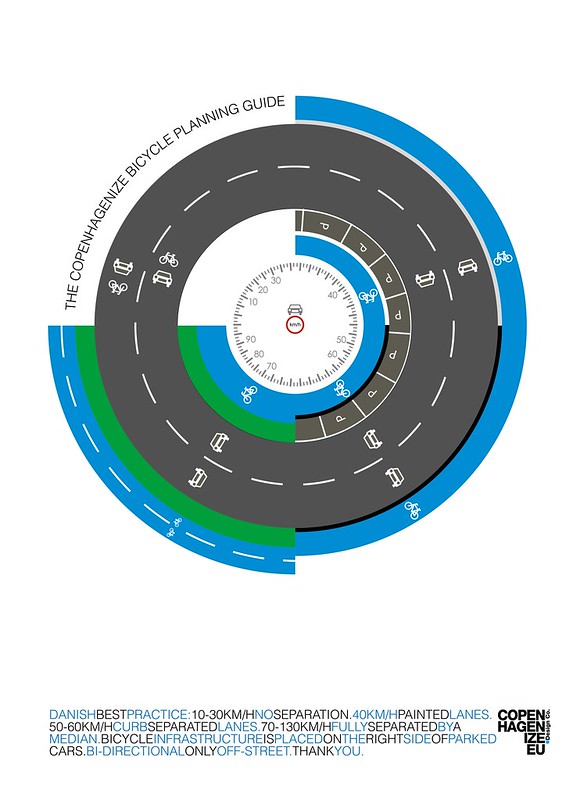
I can't completely allay cyclists fears that ultimately they will be denied road space. In large part because, now without extensive, safe or comprehensive cycling infrastructure. It is very common for a cyclist to be aggressively harassed by drivers who question their right to the road, occasionally with fatal results. So, unfortunately this is a reasonable fear, especially for established cyclists who successfully brave the current environment. What I can do is address the "Cycle Lanes Everywhere" fear. After all if cycle lanes aren't meant to be everywhere cyclists can't be restricted to them. Further, if cycling infrastructure has a clear plan places where it makes sense, and places where it doesn't maybe opposition to proper, comprehensive and safe infrastructure will diminish. Well one can hope. How to go about setting up the matrix? Well Kay Teschke Professor, School of Population and Public Health The University of British Columbia. Has done some great research on Cycling in Cities, showing relative dangers to and preferences of cyclists of all types. I really support this research it is very interesting and necessary in the North American context. But, why reinvent something someone else has done? This time form Denmark and the fine people at Copenhagenize have a perfect tool for planers and advocates:
 It is so elegant, so simple. Different provisions based on traffic speed and volume. Quiet low traffic streets, neighbourhood residential streets for instance cyclists of all ages should be able to share reasonably safely. Faster or higher volume roads get progressively more comprehensive infrastructure. Simple, no?

Thursday, August 8, 2013

Cycling In Normal Clothes Summer Addition

This is the time that many people leave their air-conditioned houses in the morning, get into air-conditioned cars to get to their place of work, which is of course air-conditioned. Not that I have anything against air-conditioning. I for one find it absolutely a necessity, in the heat of July and August.
Cycling at this time of year can be a sweaty, sticky affair. Aided some what by specialized clothing and sports drinks. All the major apparel brands use fabrics that offer to enhance the cooling effect of evaporation. UV protection is huge, too. The latest must have for sports cyclists are "Arm Coolers".
Arm-coolers & UV Protection
 Arm coolers are the exact opposite of the cyclist's staple arm-warmers combining sheer wicking fabrics and UV protection, absolutely essential if like me you don't like sunscreen. It is just not possible for the fair-skinned to spend several hours in the summer sun without getting burned.
Summer Weight Jersey
Jerseys for summer cycling are light weight, tight fitting, to promote cooling. I prefer light colours but the magic is apparently in the fabric, so dark colours work too. The ubiquitous black Lycra cycling short or bib short are not actually the best suited to hot weather. Here too, manufactures have come to the rescue weaving in wicking fabrics and breathable panels.
All this innovation works together to make 100 km Sunday tours comfortable, reducing the the risks of heat exhaustion. Allowing the cyclist to worry about the town-line sprint and important Strava segments.

As great as all this high-tech apparel is, its not much use for the 8.1 km* commute to work. Or for that matter the shorter neighbourhood trips to coffee or the shops. Lets face it wandering around in cycling gear will make one look a bit or a prat. How can the lowly bike compete with the air-conditioned convenience of the car. It can be done with a few simple tips the bike can be a comfortable and stylish ride even in the summer heat.

Slow Down: First key bit of advice. A relaxed pace will not generate as much body heat think walking not jogging. A walking level of effort will go a long way to keeping cool. You'll still cover more ground then even a brisk walk but with less effort.

Let the Bike Take the Load: No backpacks! messenger type bags are okay. Best option is a rack and pannier. You can carry what you need without putting heavy un-breathable fabric against your body, trapping heat and sweat. If you cheat even a little on the first bit of advice a pack or bag will let everyone know.

Leave Early: This helps with the first point, you will need more time to get to your destination after all. There is a practical aspect to this too. Mornings tend to be the coolest time of the day, if it's over 24c before eight you can be guaranteed it is going to be a warm day. Obviously this bit of advice is best suited to the commuter, for more social bike trips flip the advice and leave latter. Grab some lights and enjoy an evening on a patio rather then lunch in the heat of the day.

Avoid Stops: I'm not advising running red-lights or stop-signs, honestly I'm not. Stopping on the black-top even with morning sun heats up very quickly. if you can avoid it by route choice or riding more slowly, do it. Racing for a light is probably counter productive. If you slow down considerably after clearing the intersection, maybe.

Chose a Shady Route: The sun is not your friend. Shady routes are cooler in both senses of the word. They tend to be the less direct more scenic quiet routes through a city. Its OK you've got lots of time because you left early. Watch out for stop-signs, these routes usually have an abundance of them. This helps keep competition from cars to a minimum, also cool.

Dress Appropriately: Sure this is easy advice if you work in ultra casual high-tech or retail. What if your office is a little more formal. There are still options: buy a light summer weight wardrobe. Summer weight suits do exist but can be hard to find. Pack your jacket, wear an under shirt. Jackets are the heaviest and therefore warmest parts of a suit an under shirt can help protect your dress shirt if you ignore the first bit of advice. Worst case take a spare shirt to change into when you get to the office.

A Bare Head is a Cool Head: Oh, sure modern helmets are well ventilated, and an important bit of safety equipment.** If, you follow the first bit of advice and go slow the venting won't work. As every winter loving Canadian knows: you loose most heat from your head.*** In summer your head is your natural radiator any hat, helmet or other covering will inhibit this natural function and lead inevitably to over heating.

The Hottest Part of the Ride is the End: Get yourself an iced coffee, lemonade or cool drink of your choice. Go to the washroom and wash your face, change your shirt if necessary. Find that cool spot under the air-conditioning vent and allow yourself to cool down.

That is it cycling in regular clothes is possible. Getting out of the air-conditioning for a while and enjoy the summer. It is far to short autumn will be here soon enough.

* Average Ottawa commute
** A surprisingly controversial bit of safety equipment. That may not actually be that effective at the one job it has.
*** This is apparently, a wives tale. One that I am happy to perpetuate.

Sunday, July 1, 2012

Happy Canada Day!

It is a beautiful hot and sunny Canada in the Capital. I am fortunate enough to squeeze in a couple of bike rides in between visiting and lounging. I was hoping to get a ride in with Darling Daughter but Alcatel-Lucent Sunday Bikedays was suspended for Canada Day celebrations. She is focused on swimming today anyway.
Always a big deal Canada Day draws thousands to the city centre with lots of activities free concerts and fun. Unfortunately the crowds get so thick that cycling is not terribly practical, which may be part of the reason that Capital Bixi has closed several Bixi stations in the downtown core. Still cycling is a great way to get to the crowds, certainly better then driving.
Happy Canada Day! Hope you get to enjoy at least part of it on a bike.

Tuesday, June 12, 2012

Rideau Lakes Cycle Tour

This past weekend, June 9-10, I road my sixth Rideau Lakes Cycle Tour. This is one of the signature events for the Ottawa Bicycle Club and has been very well run for 41 years. This year's tour was no exception.
The tour is an organized ride from Carleton University, in Ottawa, to Queens University, in Kingston, and returning the next day. Attracting riders form all over, the tour accommodates 2,000 or so riders over four routes:
The Classic, by far the busiest route clocks in at 177km each day.
The Century, really the Classic route with the start moved to Perth. Still a respectable 100km each day
The Cruise, a more southerly route a little longer, maybe a little flatter then the Classic. Officially 179km each way.
The Challenge, 225km of hilly Eastern Ontario roads. Starting with the Classic, this route takes a northerly detour through Almont, Elphin and Boilingbroke before rejoining the Classic route before Westport.
This year I road the Challenge route on Saturday and the Cruise Sunday. Both days were brilliant. The weather was overcast, with a short period of light rain on Saturday. The rain came towards the end of my eight hours in the saddle, not so heavy as to make riding miserable. Just enough to motivate to end the ride as quickly as possible. Sunday was sunny and hot, a beautiful day with the danger of over heating. The Cruise route had good shade and everyone in our group managed to remain well hydrated. We finished strong and together. A great ride a great tour. Thanks OBC and the legion of volunteers that make this fine event possible.
I didn't bring my camera, so I'll link to a Fliker slide-show of the Ottawa Bicycle Club's Rideau Lakes Tour through the years.


If this inspires you, register early. The Tour sells out every year.