Monday, April 7, 2014

False Sense of Security

This morning this Tweet appeared in my Twitter Feed:
After several replies and a bit of "lively" debate, this response:
These two Tweets illustrate just how far cycling advocacy still has to go in Ottawa. A city that was awarded Ontario's first "Gold Bicycle Friendly Community Award from the Share the Road Cycling Coalition" (pdf) Less then two years ago.
Those were heady times, the Laurier Bike lane the cities first protected cycle lane was in full swing, very popular, successful by all metrics. The Streets, Main and Churchill were approved for cycle tracks better sidewalks and status as "Complete Streets". Heady times, momentum and political will were on the side of those of us advocating for "Livable Cities" and better cycling infrastructure. Since then it has been a steady slide back to the 1960's Parkways, Expressways and wider roads. Which brings us to the first Tweet: Here is St. Patrick Street via Google maps:
 
View Larger Map
Not only is this street the only connection between Lowertown and Vanier, it also connects Quebec's highways 50 and 5 to the Vanier Parkway. This is a busy 4 lane divided road, and while I can't say it is popular with cyclists it is one of only three spots to cross the Rideau River north of the Queensway. East of Cobourg St. it has been marked as part of the East-West Bikeway. West of Cobourg St. to Lowertown and Ottawa's Market, popular destinations, there has been no plans to accommodate cyclists. @VanierCycles has been working hard to connect Vanier to the rest of Ottawa's active transport plan. As well as make active transport a priority with in Vanier. St. Patrick is an obvious, if difficult, cycling connection. Unfortunatly the road surface is quite narrow as can be seen in this google maps Street view:


View Larger Map
As you can see not a lot of room on the existing road bed. Ignore the grass buffering the sidewalk new construction is not being considered here. No this would be a paint only project, and to accommodate a painted bike lane the road will need to be over 8 meters wide. City Engineers are telling VanierCycles a panted lane is not possible, but maybe Sharrows. Now, I am a confident cyclist I like Sharrows but they are completely inappropriate here. This is a road designed for 80 km/h officially 50 km/h. Volume is high most of the day, not a Sharrows candidate but city engineers don't want to provide a "narrow" bike lane.

Which brings us to @Centretowner's Tweet:

This is I imagine the exact thought process of the city engineers; why provide a false sense of security with a sub-optimal bike lane. This is logical, a narrow bike lane can be host to all sorts of problems, such substandard facilities will not appeal to tentative potential cyclists. The question is will they provide a "false sense of security". My unscientific personal observations is, no. Narrow substandard painted bike lanes appeal to a select few. Many people on bikes will continue to chose to ride the sidewalks or avoid the route entirely. The few who do use the route will be confident cyclists, who while not needing the painted lane, prefer that it is there. No narrow substandard bike lanes don't provide a false sense of security, they provide a little bit of security to those who need it least and none to those that need it most.
St. Patrick requires grade separated protected cycle tracks. Traffic volumes and speeds dictate this. The City engineers should say this. They should say that they don't have funding to do this at this time but here is what we can do to get there. Not offer the worst backwards "solution" available. A City that claims to care about cyclists, livable environments and core neighbourhoods wouldn't do this.
That Ottawa has says a lot.  

Monday, March 31, 2014

Bike Lanes Everywhere!

Well, maybe not everywhere...

I've been working on this post for a while now. It started when I tweeted a link to a video explaining "Protected Intersections for Cyclists" 
A novel (well not really, more on that in a bit) way of dealing with one of the most common complaints against Cycle Tracks in North America: What about the intersections?
Quickly, while there are subtle variations, Bike Lanes merge with traffic prior to intersections & Cycle tracks continue to the intersection to the right of cars and stop. Both these strategies invite conflict with other traffic at right turns, red-lights and have short comings for left-turning cyclists. Here, clearly demonstrated, is a solution. Best part, this is not a theoretical solution. This is widely used, in the Netherlands of course.  Why reinvent when others have already done all the hard work.

The reactions: "It can't be done in Ottawa, takes to much room."
"We shouldn't do this because then everyone will think that is the only place we can ride."

The room issue is complicated, but ultimately false: Issue is never is there enough just how do you choose to use it. As Easy As Riding A Bike frequently takes this on in a British context. It is the second complaint that I've been trying to get a handle on. There are two sides to this: from cyclists perspective, a fear that Cycle Tracks will inevitably lead to a loss of right to the road. Non cyclists are often exasperated thinking we want CYCLE LANES EVERYWHERE!

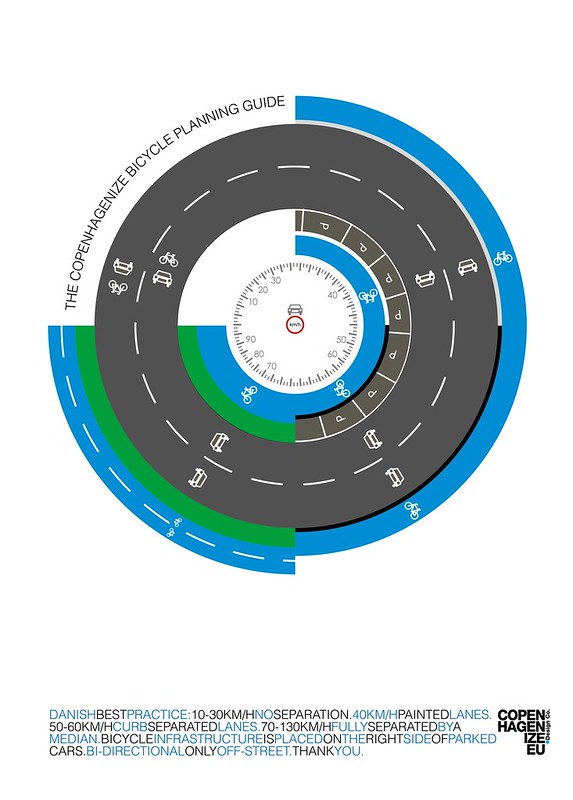
I can't completely allay cyclists fears that ultimately they will be denied road space. In large part because, now without extensive, safe or comprehensive cycling infrastructure. It is very common for a cyclist to be aggressively harassed by drivers who question their right to the road, occasionally with fatal results. So, unfortunately this is a reasonable fear, especially for established cyclists who successfully brave the current environment. What I can do is address the "Cycle Lanes Everywhere" fear. After all if cycle lanes aren't meant to be everywhere cyclists can't be restricted to them. Further, if cycling infrastructure has a clear plan places where it makes sense, and places where it doesn't maybe opposition to proper, comprehensive and safe infrastructure will diminish. Well one can hope. How to go about setting up the matrix? Well Kay Teschke Professor, School of Population and Public Health The University of British Columbia. Has done some great research on Cycling in Cities, showing relative dangers to and preferences of cyclists of all types. I really support this research it is very interesting and necessary in the North American context. But, why reinvent something someone else has done? This time form Denmark and the fine people at Copenhagenize have a perfect tool for planers and advocates:
 It is so elegant, so simple. Different provisions based on traffic speed and volume. Quiet low traffic streets, neighbourhood residential streets for instance cyclists of all ages should be able to share reasonably safely. Faster or higher volume roads get progressively more comprehensive infrastructure. Simple, no?

Sunday, March 9, 2014

Ottawa's East-West Bikeway

Or Everything wrong with Ottawa's Cycling Plans...


Ottawa's East-West Bikeway has been talked about for a long time David Reevely penned a fine piece describing the plans at the end of October, 2011. Even then only "substantial completion" was promised for Fall 2014. At first blush three years to substantially complete a 12 km Bikeway through Ottawa seems reasonable. Except of course the plan isn't to complete 12 km of bikeway, it is to link up nearly 12 km of bike routes. "Substantial completion" was really already there in 2011 two years prior to construction even starting. Here is a link to the Project PDF, a lot of existing/ improved route, less new.
Sourced form Citizen Cycle An Ottawa Citizen Cycling Blog
Connecting links is really important, All efforts to connect the disjointed cycling facilities in Ottawa should be cause for applause. Yet, here I am complaining about exactly such a plan. Why? This project represents $5 million dollars, nearly a fifth of the 10 year cycling budget. Or put another way two years of planned spending, illustrating the inadequacy of the over all budget. A fifth of the over all bike budget for what is really a modest and uninspiring project. A large section of which will be soon under buses until 2017, at least. As LRT construction forces buses out of the TransitWay trench. By far my biggest complaint is that this proposed route fails in the main goal, connecting the two neighbourhoods Westboro and Vanier. While, also avoiding many of the most interesting neighbourhoods in between.

The main commercial street in Westboro is Richmond Road. Primarily between Golden and Kirkwood. Vanier's heart is Montreal Road. Scott and Churchill is at least close to where a cyclist travelling west across the city would likely want to go. The east end of the route is a different story, heading east just over a kilometre from goal, Vanier the route heads north crosses the Saint Patrick bridge and ends not in Vanier but New Edinburgh. Beechwood Avenue itself is a fine destination with some fine pubs and shops, it is also the last section to get any improvement, 2018+. An alternate route one block south on Barrette Street is suggested in the mean time, completely bypassing the destination street, though legitimately crossing into Vanier.

I love that Ottawa is making the effort to join up its disjointed cycling infrastructure. Even if I'd rather that infrastructure were better, at least there is something. Ottawa is an awkward city to cross with several natural barriers an East West Bikeway is welcome but this plan is a lost opportunity. Rather respecting simple A-to-Bism this plan bypasses Hintenburg, Wellington West, the vibrant section of Laurier passing through Ottawa U and Sandy Hill. By-passing even, arguably, its terminus neighbourhoods of Westboro and Vanier. This is truly encapsulates everything wrong with Ottawa's cycling plans. Lots of talk, modest action and what action there is doesn't actually help people get where they want or need to go. Bikes are pushed out of neighbourhoods rather then invited in. The bike is transport as well as a leisure and commuter tool Ottawa needs to embrace all these functions. A comprehensive active transport plan can help up and coming neighbourhoods like Vanier and Wellington West as well as established neighbourhoods like Westboro and the Glebe. We just need to accept and invite the bike in.

Monday, February 3, 2014

Bikes of Varadero

b2014-01-30-09b2014-01-30-10b2014-01-30-16b2014-01-30-20b2014-01-30-29b2014-01-30-41
b2014-01-30-42b2014-01-30-45b2014-01-30-49b2014-01-30-56b2014-01-30-60b2014-01-30-67
b2014-01-30-68b2014-01-30-69b2014-01-30-70b2014-01-30-71b2014-01-30-74b2014-01-30-80
b2014-01-30-94b2014-01-30-95b2014-01-30-96b2014-01-30-99b2014-01-30-100b2014-01-30-102
Bikes of Varadero, a set on Flickr.
It has been a very cold, hard winter this year. Lots of snow, but worse deep bone chilling cold. Followed by short sharp warm spells that rather then bring relief, brought freezing rain. Streets and sidewalks flooded by pools of dirty salty slush. The family declared a week in the sun was required. While I'm normally an "embrace the season" type, I knew that this was not the year to force the issue.
A week on the beach was a perfect break for the family but a little boring for me. An excursion into town was just what was called for. I had a good day wandering the streets of Varadero, and couldn't help but notice all the people on bikes. Not a "Cyclist" in the bunch, just citizens getting around using the most convenient way available.